
Emergency water removal in Irving, TX
Four pieces of equipment, run in order, decide what a wet house looks like a week from now.
Get Help Now(972) 210-038424/7 emergency line. Free estimates from local pros.
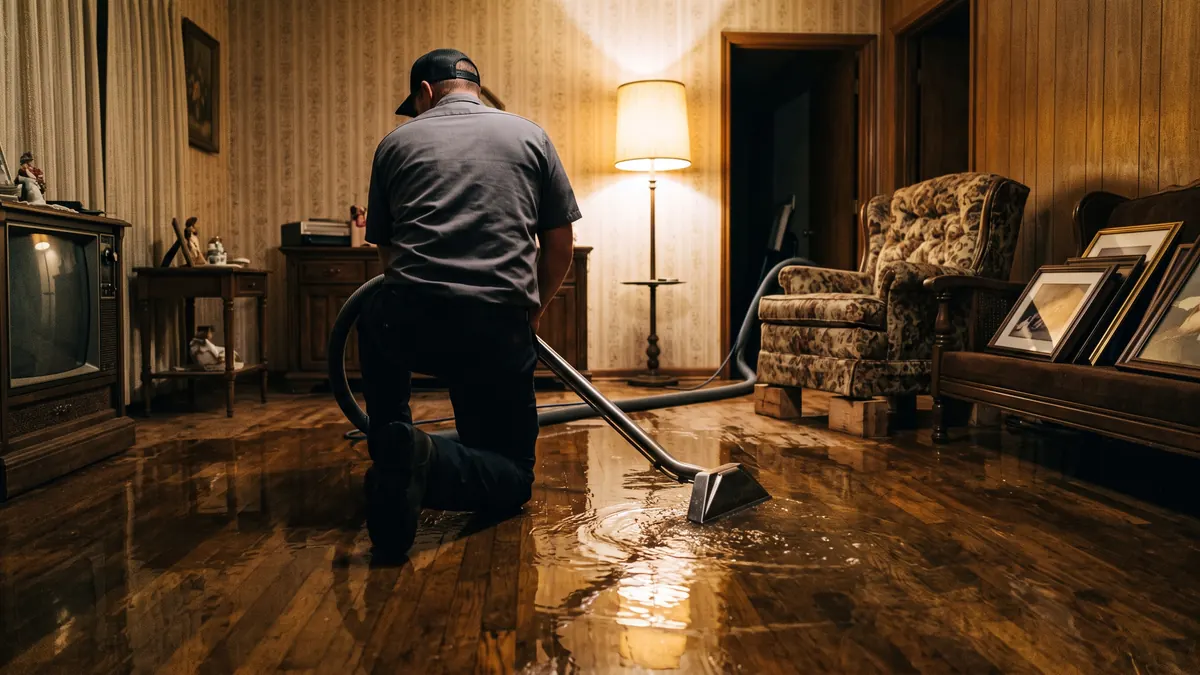
Emergency water removal means pulling standing water out fast, then running the equipment that stops the rest of the house from soaking in any deeper. A local crew works through roughly four machines over the first day: an extractor, a moisture meter, air movers, and a dehumidifier. Here’s what each one actually changes.
The extractor
Nothing else works while standing water is still sitting on the floor, so the extractor goes first. It clears far more water per minute than any household tool could manage, and that’s what lets real drying begin. If you can reach the valve behind whatever failed, close it before anything else. Can’t tell what failed? The main line into the house has its own shutoff, and closing that stops everything at once. Standing water near an outlet or a cord means flipping that breaker off before you step back into the room.
The moisture meter
A moisture meter tells a crew how far the water actually traveled, not just what’s visible from the doorway. Carpet can look fine on top while the pad underneath stays soaked, and drywall can hide a wet stud behind a surface that looks dry. Those readings become part of the record. An adjuster will eventually ask what got wet, how far it spread, and roughly when it happened, and a phone photo taken before anything gets moved answers all three better than a memory does a week later. Move whatever you can lift off the wet floor while you’re waiting: rugs, boxes, anything sitting with its legs in standing water. Speed matters more than order here.
The air movers
Air movers push moving air across wet surfaces, which speeds up evaporation far more than a closed, still room ever could. Towels pressed against the wettest spots and a window cracked for airflow won’t dry a soaked room by themselves, but they slow how fast water spreads to the parts still dry. The longer standing water sits, the more it works into carpet backing and grout lines, and the harder that becomes to reverse. Call before that soak turns into a bigger job than it needs to be.
The dehumidifier
The dehumidifier finishes what the air movers start. It pulls the moisture those machines lifted into the air back out again, so it doesn’t just resettle onto surfaces overnight. How long that stage runs depends on what’s underneath it: the drying time guide quantifies how carpet, drywall, and a concrete slab dry at different speeds. Once the equipment leaves, the water damage repair page details what happens next, room by room. The what-to-do guide lists out the fuller order of steps, from the first call through the insurance side of things.
None of this starts on its own
An extractor, a moisture meter, air movers, and a dehumidifier only do their jobs once someone’s inside your house running them. None of it starts until the call happens first. Wood floorboards swell from underneath before the surface ever looks wet, so call while there’s still a chance to catch that before the boards themselves become the damage.
Common questions
Does anyone actually pick up overnight?
Yes, the line is answered any hour, every day of the week. What happens after that, matching you with a company nearby, depends on who's available at that hour, same as during the day.
Is there a set number of days before a house is fully dry?
No single number covers every house. What material got wet, how much of it, and how long the water sat before anyone caught it all change the timeline more than the square footage does.
Is it safe to remain in the house while the equipment runs?
Often, yes, especially if only one or two rooms got wet. A larger loss, or water that reached electrical areas, may call for staying elsewhere for a stretch. Whoever looks at your specific damage can tell you which situation you're in.
Related pages
Appliance Leak Cleanup
Replacing the tank is a plumber's job. Everything the water reached before that happened is a different call.
Learn more →Burst pipe cleanup
A burst pipe can be a 1960s original line, 1980s copper, or newer PEX, and each one behaves a little differently.
Learn more →Ceiling Water Damage
A stain or drip on your ceiling started somewhere else. Tracing it back tells you who to call first.
Learn more →Commercial Water Damage
Four different people might spot the same wet floor first, and the response shouldn't depend on which one it is.
Learn more →Talk to a local pro now
We answer 24/7. One call gets a Irving crew moving on your water damage, with a free estimate and help with your insurance claim.
Get Help Now(972) 210-0384Free estimates. No obligation to hire.